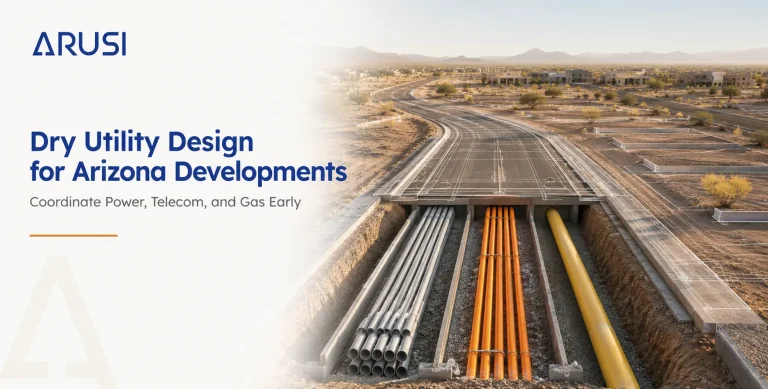
Every capital project shares its corridor with someone else. Power lines, gas mains, fiber, water and sewer got there first, and each one has an owner with its own standards, its own review queue and its own view of what moving a facility should cost.
Utility coordination is the work of bringing those owners into the project early enough that their facilities shape the design instead of surprising it. Done well, it’s mostly invisible. Done late, it shows up as a redesign, a relocation nobody budgeted for, or a contractor waiting on an approval that hasn’t arrived.
Here’s what utility coordination services cover, where projects tend to lose time, and how to tell whether yours is set up to hold its schedule.
What utility coordination services cover
On a road widening, a new development or a public works upgrade, coordination usually includes five pieces of work:
- Identifying every facility in the corridor. Records research, owner contacts and field verification, so the design starts from what’s really there.
- Finding conflicts on paper. Existing utilities go onto the proposed design, and every collision is flagged while a fix still costs a line on a drawing.
- Agreeing each resolution with its owner. Protect in place, relocate, or design around it. Every decision needs the owner’s sign-off and a clear split of who designs what and who pays.
- Tracking relocations against the project schedule. Owners work on their own timelines. Someone needs to hold those dates next to the project’s milestones and raise the flag when they drift.
- Keeping the record current. Agreements, approvals and changes are documented so the project team, the owners and the next project can all rely on them.
None of this replaces the owners’ own engineering. It connects their work to yours.
Where capital projects lose time
Most utility delays aren’t caused by a hard engineering problem. They come from timing.
Conflicts found at 90% design. By the time plans are nearly final, every conflict becomes a redesign. The same conflict found at 30% is a conversation.
Owners brought in after the plans are set. A utility asked to react to finished drawings has every reason to push back. A utility invited to help shape the corridor is far more likely to work with you.
Relocations that start too late. Relocation design and approval run on the owner’s calendar, and that calendar doesn’t speed up because a bid date is close.
Records nobody verified. Old maps and drawings are a starting point, not the answer. Facilities get moved, abandoned, or were never built quite where they were drawn.
How a coordination effort runs, start to finish
- Kickoff and inventory. Records come in from every owner in the corridor, contacts are confirmed and a conflict log is set up.
- Conflict analysis at early design. Existing facilities go onto the design base. Each conflict gets a number, an owner and a proposed resolution.
- Owner meetings and agreements. Each owner reviews the conflicts that affect them. Decisions, responsibilities and dates are written down and shared.
- Relocation tracking. As owners design and schedule their work, it’s tracked against your milestones, with early warning when dates slip.
- Closeout. Final agreements, approvals and as-built information go into one record the project can hand over.
The steps are simple. The value comes from starting them early and keeping them moving.
Signs your project needs a utility coordinator
- Three or more utility owners share the corridor.
- Design is past 30% and the owners haven’t reviewed it.
- The schedule says relocations happen “before construction,” with no dates attached.
- Existing utility information comes from records alone.
- Several agencies or jurisdictions review the same project.
Two or more of these is a good reason to bring the owners in now, while a fix is still cheap.
What to look for in a coordination partner
A good coordinator speaks both languages: the project’s and the utility’s. Look for a team that:
- understands electric, gas and telecom design well enough to propose realistic fixes, not just flag problems
- knows the local owners, their standards and their review processes
- documents every decision, so nothing depends on one person’s memory
- stays with the project from inventory through closeout
That last point matters more than it looks. Coordination runs on relationships, and continuity keeps those relationships working.
How ARUSI approaches utility coordination
ARUSI has engineered and designed for utilities in Arizona since 1987. Our utility engineering coordination and consulting work sits alongside our transmission and distribution, telecommunications and CAD teams, so the people resolving a conflict understand the facility on both sides of it.
We’re a Service-Disabled Veteran-Owned Small Business based in Phoenix, with more than 50 professional staff and a team that stays with a project from start to finish. For agencies and prime contractors, our SDVOSB status can also support federal, tribal and municipal set-aside goals.
Planning a capital project in a crowded corridor? We’d be glad to talk it through early. Contact our team.
Frequently asked questions
What is utility coordination? Utility coordination is the process of identifying every existing utility in a project corridor, finding where those facilities conflict with the proposed design, and agreeing the resolution with each owner before construction begins.
When should utility coordination start? At the start of design, or as close to it as possible. Conflicts found at early design cost far less to resolve than conflicts found near final plans or in the field.
Who pays for utility relocations? It depends on the facility, the existing agreements and the jurisdiction. Part of coordination is settling responsibility for each relocation in writing, early.
Is utility coordination the same as utility locating? No. Locating marks facilities in the field. Coordination uses that information, along with records and owner input, to resolve conflicts with the design and keep relocations on schedule.
Does ARUSI build or relocate utilities? No. ARUSI provides engineering, design and coordination support. Relocation work is carried out by the utility owners and their contractors.